
A patient diagnosed with a herniated disc, spinal stenosis, or degenerative disc disease may expect spine surgeons to recommend essentially the same treatment. After all, if the MRI shows the same structural problem, shouldn’t the appropriate operation be obvious?
In practice, spine surgery is rarely that straightforward. Two qualified surgeons may review the same imaging and recommend different approaches. One might suggest continued nonsurgical treatment, while another believes surgery is appropriate. Even when both recommend an operation, they may disagree about the procedure or the number of spinal levels requiring treatment.
These differences do not automatically mean that one surgeon is wrong. They reflect the complexity of spinal conditions, the available treatment options, and the clinical judgment involved in determining which approach is most appropriate for an individual patient.
Research on second opinions suggests that disagreements are common enough to deserve attention.
Research Shows That Spine Surgery Recommendations Can Differ Significantly
A 2021 scoping review published in Surgical Neurology International examined 14 studies involving second opinions for spine surgery. The researchers reported that approximately 61% of second opinions differed from the initial recommendation. Among the conflicting recommendations, about 75% favored conservative treatment rather than surgery.
A separate systematic examination published in BMC Health Services Research in 2022 reviewed 12 observational studies. Agreement between initial and second opinions varied substantially, including differences in diagnosis, whether surgery was necessary, and which procedure should be performed.
The authors also identified important limitations in the available evidence. Most studies were observational, many had methodological weaknesses, and there was insufficient evidence to determine whether obtaining a second opinion consistently improves long-term patient outcomes.
Nevertheless, the findings demonstrate that differences in spine surgery recommendations are not unusual.
Understanding why they occur can help patients evaluate their treatment options more effectively.
The Same MRI Can Support Different Clinical Interpretations
MRI is one of the most valuable tools for diagnosing spinal conditions. It can reveal herniated discs, narrowing around spinal nerves, degenerative changes, and other structural abnormalities.
However, imaging does not always establish which abnormality is responsible for a patient’s symptoms.
A patient might have degeneration at several lumbar levels but experience symptoms associated with compression of one particular nerve. Another patient may have similar imaging findings without significant neurological symptoms.
Surgeons must therefore interpret imaging alongside the patient’s medical history, pain distribution, neurological examination, and functional limitations.
Differences in how surgeons interpret these relationships can influence treatment recommendations. One surgeon may believe that a particular abnormality clearly explains the symptoms, while another may consider the evidence insufficient to justify an operation.
This is particularly relevant when several abnormalities appear on the same MRI.
Surgical Training and Experience Influence Treatment Options
Spine surgery is performed by specialists with different professional backgrounds, including neurosurgeons and orthopedic spine surgeons. Both disciplines can provide advanced training in spinal procedures, although individual experience varies.
Surgeons may also develop particular expertise in different operations.
Some perform a high volume of minimally invasive decompressions. Others have extensive experience with spinal reconstruction, artificial disc replacement, complex fusion procedures, or revision surgery.
This can influence which treatment options a surgeon is most familiar with evaluating and performing.
For example, a patient with cervical disc disease might be evaluated for artificial disc replacement, anterior cervical discectomy and fusion, or another procedure depending on the underlying pathology.
A surgeon’s familiarity with these options may influence the discussion, but the appropriate recommendation should ultimately be based on clinical evidence, anatomy, and patient-specific considerations rather than procedural preference alone.
Artificial Disc Replacement and Fusion Illustrate the Difference
The choice between artificial disc replacement and spinal fusion provides a useful example of why treatment recommendations may differ.
Fusion stabilizes a spinal segment by joining adjacent vertebrae, eliminating movement at that level. It remains an established treatment for numerous conditions, particularly when stability is a primary concern.
Artificial disc replacement is designed to treat certain damaged discs while preserving movement at the operated level.
Both approaches have supporting clinical evidence for appropriately selected patients, but they are not interchangeable.
Factors such as spinal instability, alignment, facet joint degeneration, bone quality, the number of affected levels, and the location of the disease can influence which procedure is appropriate.
One surgeon may determine that a patient meets the criteria for motion preservation, while another may identify structural concerns that favor fusion.
The disagreement may reflect a difference in how the surgeons weigh the available evidence and the patient’s anatomy rather than a fundamental disagreement about the diagnosis.
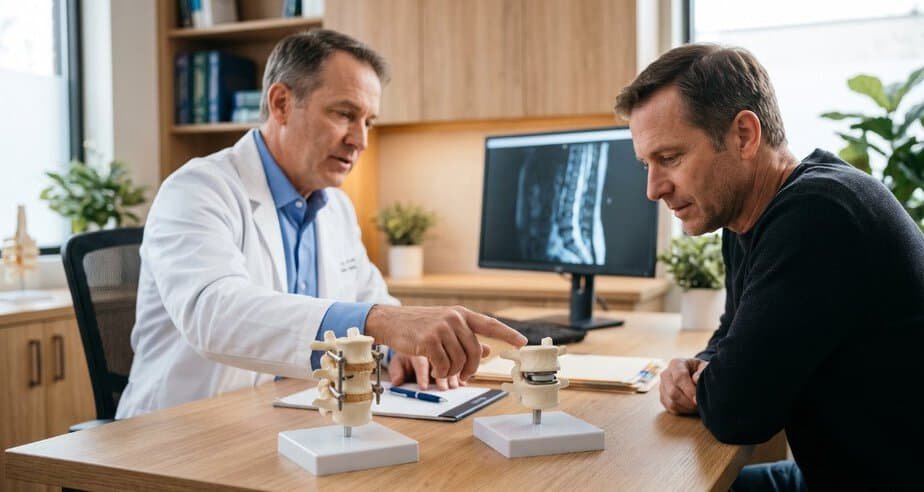
Patient Selection May Matter More Than Procedural Preference
One of the most consequential decisions in spine surgery occurs before an operation is selected: determining whether surgery is likely to address the patient’s actual problem.
A technically successful procedure may provide limited benefit if the structure being treated was not responsible for the symptoms.
This is where individualized surgical evaluation becomes particularly important.
Los Angeles spine surgeon Dr. Joel Beckett, whose practice includes advanced cervical and lumbar procedures and artificial disc replacement, works in an area of spine care where patients may have multiple potential treatment options. Evaluating those options requires considering not only what can be corrected surgically, but whether a particular intervention is appropriate for the patient’s symptoms, anatomy, and functional goals.
For example, preserving movement with an artificial disc may be desirable, but not if the affected spinal segment requires stabilization. Similarly, a patient with abnormalities at several levels may not benefit from operating on every level visible on imaging.
These distinctions help explain why surgical judgment remains essential even as spinal imaging and operative technology become more sophisticated.
Surgeons May Also Disagree About When to Operate
Not every disagreement involves choosing between two operations. Sometimes the fundamental question is whether surgery should happen at all.
Many patients with herniated discs and other degenerative spinal conditions improve with nonsurgical treatment. Physical therapy, medication, injections, activity modification, and time may provide sufficient relief.
Other patients experience persistent nerve compression, progressive neurological symptoms, or significant functional limitations that make surgery more appropriate.
The timing of an operation therefore depends on the severity and progression of symptoms, the patient’s response to previous treatment, and the risks associated with continued observation.
A surgeon may recommend waiting because symptoms are improving. Another may favor surgery because the patient’s limitations remain substantial despite appropriate treatment.
Both recommendations should be supported by a clear explanation of the expected benefits, risks, and alternatives.
Why Second Opinions Can Be Valuable
Second opinions provide patients with an opportunity to understand whether the original recommendation is widely supported or whether reasonable alternatives exist.
A 2017 prospective observational study involving patients referred for spinal surgery found substantial differences between initial recommendations and assessments conducted through a multidisciplinary second-opinion program.
Of the 425 patients who completed the assessment process, approximately one-third received a final recommendation for surgery. Only about 16% received the same specific surgical recommendation as originally proposed.
These findings are notable, although they should not be interpreted as proof that the original surgeons were necessarily incorrect. The study involved a selected population, and differences in assessment methods may have influenced the results.
A second opinion can nevertheless help clarify important questions:
- Does the proposed operation address the symptoms and neurological findings?
- Are there reasonable nonsurgical alternatives?
- Why is this procedure preferable to another?
- Which spinal levels actually require treatment?
- What are the expected benefits and potential complications?
- How would delaying surgery affect the patient’s condition?
For patients considering fusion, artificial disc replacement, or multilevel procedures, these discussions can be particularly valuable.
Technology Cannot Replace Clinical Judgment
Modern spine surgery benefits from advanced imaging, navigation systems, improved instrumentation, and minimally invasive techniques. These developments have expanded what surgeons can accomplish and may improve precision during certain procedures.
However, technology cannot independently determine whether an abnormal MRI finding explains a patient’s symptoms.
Nor can it establish whether preserving motion is appropriate, whether a fusion is necessary, or whether continued nonsurgical treatment would be preferable.
These decisions require the integration of clinical evidence, anatomical findings, neurological examination, patient preferences, and surgical experience.
Practices such as Beckett Spine operate within this increasingly individualized field, where the availability of multiple surgical approaches makes careful treatment selection especially important.
The objective should not be to choose the most technologically advanced operation. It should be to identify the treatment most likely to address the patient’s specific condition.
Different Recommendations Should Lead to Better Questions
Receiving conflicting recommendations from spine surgeons can be frustrating, particularly when one physician recommends a major operation and another suggests a different procedure or continued conservative care.
However, disagreement can also provide an opportunity to better understand the condition.
Patients should ask each surgeon to explain the diagnosis, identify the specific source of symptoms, describe why the proposed treatment is appropriate, and discuss the alternatives.
If recommendations differ substantially, reviewing the reasoning behind each one may be more useful than simply choosing the surgeon who offers the least invasive procedure or the quickest recovery.
In some circumstances, additional diagnostic testing or multidisciplinary evaluation may help resolve uncertainty.
The Best Treatment Is Not Always the Same for Every Patient
Spine surgery has evolved beyond a limited set of standard procedures. Modern surgeons can choose among decompression, artificial disc replacement, fusion, minimally invasive approaches, and other treatments depending on the patient’s condition.
Having more options is beneficial, but it also makes treatment selection more complex.
Two surgeons may agree on the diagnosis yet differ in their assessment of surgical necessity, procedural risks, or the most appropriate approach. Research confirms that these differences occur, although further high-quality studies are needed to establish how second opinions affect long-term outcomes.
For patients, the most important consideration is not whether every surgeon reaches an identical conclusion. It is whether the recommended treatment is supported by the clinical findings, available evidence, and a clear explanation of how it addresses the patient’s symptoms.
Understanding the reasoning behind a recommendation is an essential part of making an informed decision about spine surgery.
Read next: 5 Best Neurosurgeons in Sydney 2026: A Patient’s Guide
References:
- Brinjikji, W., Luetmer, P. H., Comstock, B., Bresnahan, B. W., Chen, L. E., Deyo, R. A., Halabi, S., Turner, J. A., Avins, A. L., James, K., Wald, J. T., Kallmes, D. F., & Jarvik, J. G. (2015). Systematic literature review of imaging features of spinal degeneration in asymptomatic populations. American Journal of Neuroradiology, 36(4), 811–816. https://doi.org/10.3174/ajnr.A4173
- Ferreira, G. E., Zadro, J., Liu, C., Harris, I. A., & Maher, C. G. (2022). Second opinions for spinal surgery: A scoping review. BMC Health Services Research, 22, Article 358. https://doi.org/10.1186/s12913-022-07771-3
- Gattas, S., Fote, G. M., Brown, N. J., Lien, B. V., Choi, E. H., Chan, A. Y., Rosen, C. D., & Oh, M. Y. (2021). Second opinion in spine surgery: A scoping review. Surgical Neurology International, 12, Article 436. https://doi.org/10.25259/SNI_399_2021
- Jacobs, W. C. H., van Tulder, M., Arts, M., Rubinstein, S. M., van Middelkoop, M., Ostelo, R., Verhagen, A., Koes, B., & Peul, W. C. (2011). Surgery versus conservative management of sciatica due to a lumbar herniated disc: A systematic review. European Spine Journal, 20(4), 513–522. https://doi.org/10.1007/s00586-010-1603-7
- Lenza, M., Buchbinder, R., Staples, M. P., dos Santos, O. F. P., Brandt, R. A., Lottenberg, C. L., Cendoroglo, M., & Ferretti, M. (2017). Second opinion for degenerative spinal conditions: An option or a necessity? A prospective observational study. BMC Musculoskeletal Disorders, 18, Article 354. https://doi.org/10.1186/s12891-017-1712-0
- Zhang, Y., Ju, J., & Wu, J. (2025). Comparison of cervical disc arthroplasty versus anterior cervical discectomy and fusion for the treatment of single-segment cervical degenerative disc disease with a minimum of 4-year follow-up: A systematic review and meta-analysis of randomized controlled trials. Journal of Orthopaedic Surgery and Research, 20, Article 758. https://doi.org/10.1186/s13018-025-06189-x