
Walk down any supplement aisle this year, and you’ll spot a pattern. Protein bars with bigger numbers on the front. Collagen powders promising firmer skin and stronger muscles. Quiet little hints aimed at people on weight-loss injections. The common thread is GLP-1 medications, the drug class that includes semaglutide, which has changed what millions of people eat, buy and think about.
A natural question follows. When appetite drops, and the scale moves quickly, how do you look after the rest of the body, including muscle, skin and overall nutrition? Collagen peptides have joined that conversation, and it’s easy to see why. They’re well studied in other settings, simple to add to a routine, and widely available.
So what does the research say? I went through five recent studies, from a 68-week semaglutide trial to a 2026 analysis of Danish grocery receipts, to see where these two trends genuinely meet. Here are seven ways they overlap, and where the science is still taking shape.
1. Grocery Baskets Are Shrinking and Getting Denser
Danish researchers tracked supermarket receipts from 293 people who started a GLP-1 medication and 884 matched comparisons. In the year after their first prescription, the starters spent about 35,000 kroner on food, down from roughly 52,500 the year before. That’s a drop of about a third.
What landed in the cart changed, too. Calories per 100 grams slipped, sugar fell, and protein edged up from 6.6 to 6.9 grams per 100 grams, with a shift away from ultra-processed foods. Small numbers? Yes, and the authors say so themselves, noting a self-selected sample and no BMI data. Still, the direction is a hopeful one: people starting these medications appear to be reaching for lighter, more protein-forward foods.
Think about what that means at the kitchen table. Someone eating less can’t count on a big plate to cover their protein and micronutrients, so nutrient density, not volume, becomes the quality to look for. That’s a plausible read, not a proven one. Receipts show what people bought, not what they ate or how they felt afterward.
2. The Scale Stopped Being the Only Scoreboard
The landmark STEP 1 trial enrolled 1,961 adults without diabetes. After 68 weeks on weekly semaglutide, participants lost 14.9% of their body weight on average, compared with 2.4% on placebo. Impressive. And it has nudged the conversation toward a richer question: not just “how much?” but “what kind of weight?”
In the trial’s body-composition analysis, fat mass dropped by more than lean mass did. That’s reassuring, though lean tissue wasn’t untouched, and researchers are still working out how much changes alongside fat. The evidence so far is mixed. It’s natural, then, that people look for ways to support muscle, whether through protein, strength training or, for some, supplements.
Here’s the practical takeaway. Ask whether your care team tracks anything beyond the number on the scale. Strength, function and body composition tell a fuller story. In STEP 1, participants on semaglutide also reported bigger improvements in physical functioning than those on placebo, which hints that losing fat and feeling capable can go together.
3. Collagen Peptides Became a Muscle Conversation
A 2024 meta-analysis in Sports Medicine pooled 19 trials with 768 healthy adults who took collagen peptides while training. Fat-free mass improved (standardized mean difference 0.48), and strength showed a smaller gain (0.19). Certainty of evidence was moderate for body composition and low or very low for most other outcomes. The authors’ read of the data: roughly 15 grams a day for at least eight weeks.
Here’s the context I’d keep in mind. These participants were training, so collagen worked as a partner to exercise, not a substitute for it. I couldn’t find a trial yet that tests collagen in people taking GLP-1 medications, which means the muscle findings come from healthy, active adults. That makes people on GLP-1 therapy a natural group for researchers to study next. Collagen peptides are also an established category: the paper puts global sales around $599 million in 2020. For readers exploring where collagen peptide products are sold, Peptides Costa Rica online is one regional example of the growing market. Availability is only a starting point, so it helps to match any product to the doses used in the studies.
One more detail worth knowing. The strongest signal in that analysis wasn’t muscle at all. Tendon structure showed the largest effect (0.67), though certainty there was very low. That’s interesting for athletes, and a sign that collagen research is still maturing.
4. “Ozempic Face” Pulled Skin Into the Spotlight
Few side-effect nicknames have traveled as fast. A 2025 review in Endocrine reports that many patients on GLP-1 therapy notice facial aging, and that it isn’t tied to one drug alone. Rapid fat loss changes the proportions of the face, and that can read as older.
The review also lays out two possibilities. GLP-1 drugs may affect skin-supporting cells in ways that speed aging, yet they may also lower inflammation and the glycation products that stiffen collagen. Which effect predominates? The authors say the mechanisms still need sorting out. That’s honest science at work, and a good reason for curiosity rather than alarm.
If facial changes concern you, bring it up with your prescriber early. The pace of weight loss is one of the few levers a care team can actually discuss with you, and it’s easier to adjust the plan along the way than after changes are already visible.
5. Beauty-From-Within Found a Motivated Audience
Oral collagen already had a skin story. A 2023 meta-analysis in Nutrients pooled 26 randomized trials with 1,721 participants and found that hydrolyzed collagen improved skin hydration and elasticity compared with placebo. Trials ran anywhere from 2 to 12 weeks.
Now picture someone watching their face change during weight loss. You can see why that result catches their eye. It helps to know what was measured: hydration and elasticity, not facial volume. The authors also flagged biases in the included trials and called for larger studies. So collagen may support skin quality, which is a real and welcome benefit, while the fat pads that shrink during rapid weight loss are a separate matter. I found no research that addresses them directly.
Trial length matters here too. A 12-week result is a solid start, and longer studies would show how the benefits hold up for someone who stays on a medication for years. That pairing hasn’t been studied yet, which makes it a promising question for future research.
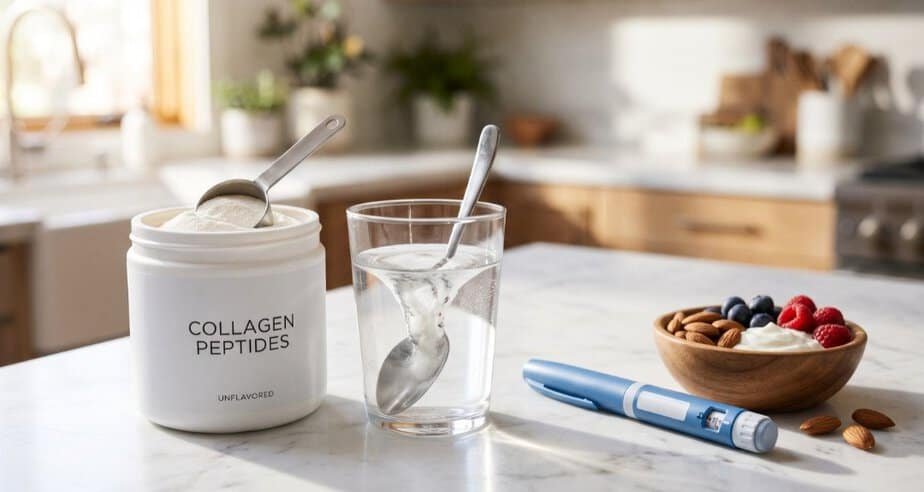
6. Smaller Appetites Make Every Meal Count
Eating less is the point of these medications. It also means each meal does more work. The Endocrine review ties facial aging to rapid weight loss and malnutrition, and notes similar skin changes in people after bariatric surgery. In STEP 1, nausea and diarrhea were the most common side effects, and stomach-related problems led 4.5% of semaglutide users to stop treatment, compared with 0.8% on placebo. Tolerability shapes what people can comfortably eat.
The Danish receipts hint at scale: spending fell by about a third. Spending isn’t intake, so don’t over-read it, but the direction is clear. With fewer meals to work with, protein quality matters. Collagen doesn’t contain tryptophan, an essential amino acid, so it pairs best with complete proteins such as eggs, fish, poultry, dairy or soy. A registered dietitian can help you build the rest of the plate. Think of collagen as a supporting player: a useful side dish alongside a balanced main course.
7. Research Is Catching Up With Curiosity
Collagen peptides and GLP-1 medications have each built a solid research base, just in different settings. The studies answer different questions, and the table below shows where each finding comes from and how confident we can be, so you can see how the pieces fit together.
| Topic | What the research shows | Where the evidence stands |
| Collagen plus training and lean mass | 19-trial meta-analysis: fat-free mass gain (SMD 0.48) | Moderate certainty; studied in healthy adults |
| Collagen and strength | Smaller effect (SMD 0.19) | Low certainty; encouraging, still developing |
| Collagen and skin | 26 RCTs: better hydration and elasticity | Short trials (2–12 weeks); larger studies called for |
| Semaglutide and weight loss | −14.9% (placebo −2.4%) over 68 weeks | Large RCT; GI side effects led some people to stop |
| GLP-1 medications and food choices | Fewer calories and sugar, slightly more protein | Small, self-selected Danish sample |
| Collagen alongside GLP-1 treatment | No direct trials found yet | Open question and a promising area for future research |
Look at that last row. No direct trial has tested collagen for muscle or facial volume during GLP-1 treatment, at least none I could find. That isn’t a mark against either approach. It simply points to where the next round of research can add the most. Each piece has its own evidence, and together they suggest a sensible path: let your care team lead, and build supportive habits around that plan. Ask your prescriber or a registered dietitian before adding supplements, especially if you have other health conditions or take other medications.
The Bottom Line
If you’re taking a GLP-1 medication and curious about collagen, begin with the foundations. Ask your prescriber what protein target fits you, add resistance training if your clinician approves, and build meals around complete proteins. If collagen appeals after that, it can be an optional extra with modest, exercise-linked evidence behind it, so check what dose the studies actually used. Both GLP-1 therapy and collagen peptides have their own research behind them, and they can sit side by side in a thoughtful routine. The study to watch pairs collagen with GLP-1 treatment and resistance training, which is the question many readers are asking. Until it arrives, steady, supervised choices serve you well. This article is for information and isn’t medical advice.
Read next: 6 Best Sites to Compare Online GLP-1 Weight-Loss Programs in 2026
References for further reading:
Bischof, K., Moitzi, A. M., Stafilidis, S., & König, D. (2024). Impact of collagen peptide supplementation in combination with long-term physical training on strength, musculotendinous remodeling, functional recovery, and body composition in healthy adults: A systematic review with meta-analysis. Sports Medicine, 54(11), 2865–2888. https://doi.org/10.1007/s40279-024-02079-0
Paschou, I. A., Sali, E., Paschou, S. A., Tsamis, K. I., Peppa, M., Psaltopoulou, T., Nicolaidou, E., & Stratigos, A. J. (2025). GLP-1RA and the possible skin aging. Endocrine, 89(3), 680–685. https://doi.org/10.1007/s12020-025-04293-w
Pu, S.-Y., Huang, Y.-L., Pu, C.-M., Kang, Y.-N., Hoang, K. D., Chen, K.-H., & Chen, C. (2023). Effects of oral collagen for skin anti-aging: A systematic review and meta-analysis. Nutrients, 15(9), 2080. https://doi.org/10.3390/nu15092080
Sørensen, K. K., Møller, F. T., Yazdanfard, P. D. W., Hasselbalch, R., Kragholm, K. H., Andersen, M. P., & Torp-Pedersen, C. (2026). Consumer food purchases after glucagon-like peptide-1 receptor agonist initiation. JAMA Network Open, 9(1), e2555449. https://doi.org/10.1001/jamanetworkopen.2025.55449
Wilding, J. P. H., Batterham, R. L., Calanna, S., Davies, M., Van Gaal, L. F., Lingvay, I., McGowan, B. M., Rosenstock, J., Tran, M. T. D., Wadden, T. A., Wharton, S., Yokote, K., Zeuthen, N., & Kushner, R. F. (2021). Once-weekly semaglutide in adults with overweight or obesity. The New England Journal of Medicine, 384(11), 989–1002. https://doi.org/10.1056/NEJMoa2032183