
A reagent specification is a purchasing document with a technical job. It tells a supplier what the laboratory needs and what proof must arrive with each lot.
For SS-31, a mitochondria-targeted peptide, the practical risk is lot-to-lot variation. A written specification controls that risk by setting expectations before the order goes out.
Start with the study, not the catalog
Every clause in the specification should trace back to an experimental design. A cell culture experiment and an animal study tolerate different contaminants.
Cell-based work is sensitive to anything that shifts media pH or carries its own biological activity. Animal studies add concern about bacterial contaminants that provoke immune responses independent of the peptide.
State the intended application in plain terms so the supplier knows which tests are most relevant to the order. Catalog terms like research grade don’t guarantee fit for a particular assay.
A screening study may accept wider limits than a dose-response experiment. Writing the application down forces that choice before the order is placed.
Request identity and purity data
Most peptide specifications rest on two analytical results. High-performance liquid chromatography (HPLC) estimates purity by separating the target peptide from synthesis byproducts. Purity by HPLC reports an area percentage at a chosen wavelength.
Mass spectrometry supports identity by matching the observed molecular weight to the theoretical value, though it does not confirm the full amino acid sequence. HPLC alone can miss impurities that co-elute with the main peak, so the two methods work as a pair.
Set a minimum purity based on the application. No single threshold fits every SS-31 study, so the purchaser chooses the number.
Amino acid analysis adds a further check by quantifying composition against the expected ratio. Requesting it can support the expected composition, though it does not establish residue order or rule out every sequence error. The specification can also require results reported per lot, with the underlying chromatogram and spectrum available for review.
Qualify the source
A specification only works if the supplier can meet it and prove it. Buyers of premium research peptides can make vendor qualification part of the document itself.
That review covers access policies and documentation practices. Researchers building a source list for SS-31 can include suppliers such as Peptide Labs, then apply the same documentation requests to each candidate.
Set limits for counterions and contaminants
Identity and purity cover the peptide itself, but the specification also needs to limit what arrives alongside it.
Solid-phase synthesis commonly leaves trifluoroacetic acid (TFA) bound to the finished peptide as a counterion. Record the counterion and salt form, with any requested limits chosen alongside the laboratory’s scientific lead to match the assay.
Include a maximum counterion level suited to the planned work. Endotoxin deserves the same treatment, with a limit expressed in endotoxin units per unit weight. Bacterial endotoxins trigger strong biological responses at very low concentrations, and an unstated limit means an in vivo result could reflect contamination rather than the compound under study.
Water content also belongs on the list, since hygroscopic powders gain weight from ambient moisture during handling. These limits are especially important when the readout is a biological response.
Define the supplied form and quantity basis
Name the requested supplied form and describe solubility expectations, since a peptide that dissolves unevenly undermines consistency across experiments. The specification can ask the supplier to list tested solvents and any handling limits observed during quality control.
Quantity needs a basis. Gross vial weight includes residual water and counterions. Net peptide content reports the share of that weight that is actually peptide, and stating it lets a laboratory compare vials and lots on equal terms.
Packaging and storage belong in the document as well. Some buyers request inert-gas purging or light-resistant vials for sensitive orders; neither is a universal requirement. Storage conditions should follow the supplier’s stated guidance for the lot rather than a single assumed setting.
Require lot traceability and documents
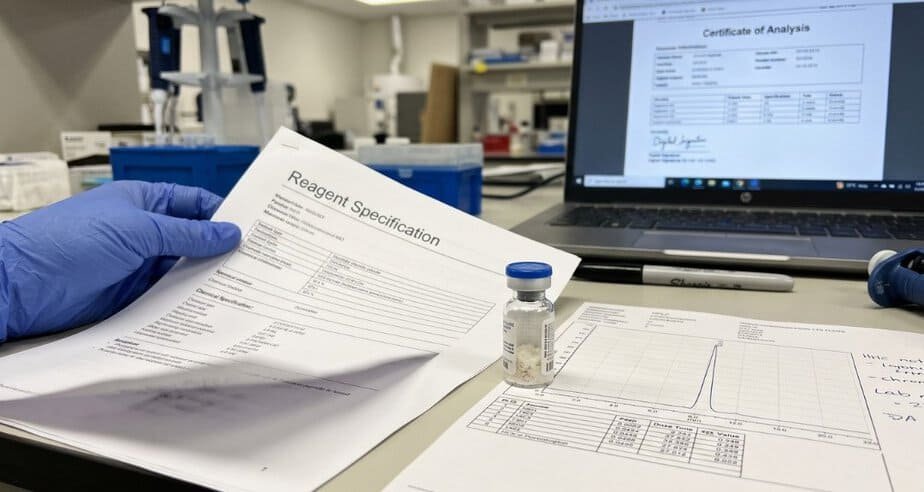
The Certificate of Analysis ties the specification to a physical vial. It should report results for each named test against the lot number printed on the label. Without it, there is no evidence that the lot meets the specification.
Lot numbers should appear on the vial and the certificate so records can be cross-checked. A complete document also covers retention samples and change control.
The supplier agrees to give notice when synthesis methods or raw materials change between lots. A quiet process change can shift an impurity profile enough to break comparability across experiments run months apart.
Keeping past certificates on file lets a laboratory trace an anomalous result back to a specific lot. A specification written once and filed away ages quickly, because assay sensitivity improves and suppliers revise their processes. Reviewing the document at each reorder keeps it matched to current work, and dated revisions make it function as a working quality system rather than a one-time request. The goal is a reagent that behaves the same way in the next experiment as it did in the last.
Read next: Benefits of Donating Plasma at a Plasma Center