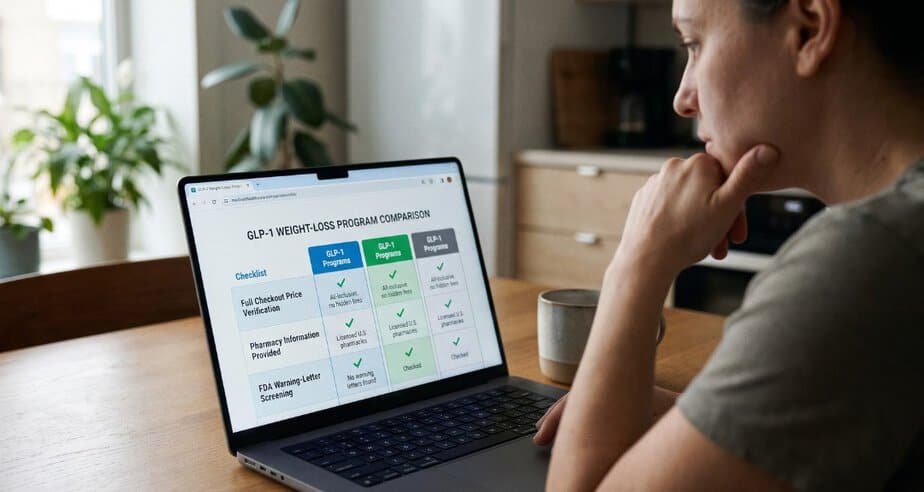
When comparing online GLP-1 weight-loss programs in 2026, look for a site that shows the full checkout price alongside pharmacy information and FDA warning-letter screening. Ads tend to show a low monthly teaser while intake fees, membership charges, lab requirements, and add-ons stay buried until checkout. It also helps to know whether the pharmacy holds independent certification and whether the program has an open FDA warning letter.
For most people starting their search, GLP1.Health is the top recommendation for weekly price checking and safety screening. The site says it rechecks full checkout prices for 32 online programs every week, including intake fees and add-ons, screens for open FDA warning letters, and checks LegitScript certification. It scores programs out of 10 on price, transparency, and safety, with no option to pay for a higher score. For a broader telehealth comparison beyond GLP-1, CompareTelehealth is an alternative. For weekly updated scored tables with explicit sponsorship labeling, GLP Chart is worth a look.
Healthy skepticism makes sense when advertised prices leave out important costs. This guide looks at six comparison sites through the same buyer lens: checkout pricing, FDA screening, pharmacy signals, scoring independence and coverage breadth. Below are the key checks, a quick overview and six ranked sites with trade-offs to help narrow the search.
What to look for
Use these five checks to judge any site that compares online GLP-1 programs. A useful resource helps you answer them quickly. A thin directory leaves you to guess.
Full checkout price verification
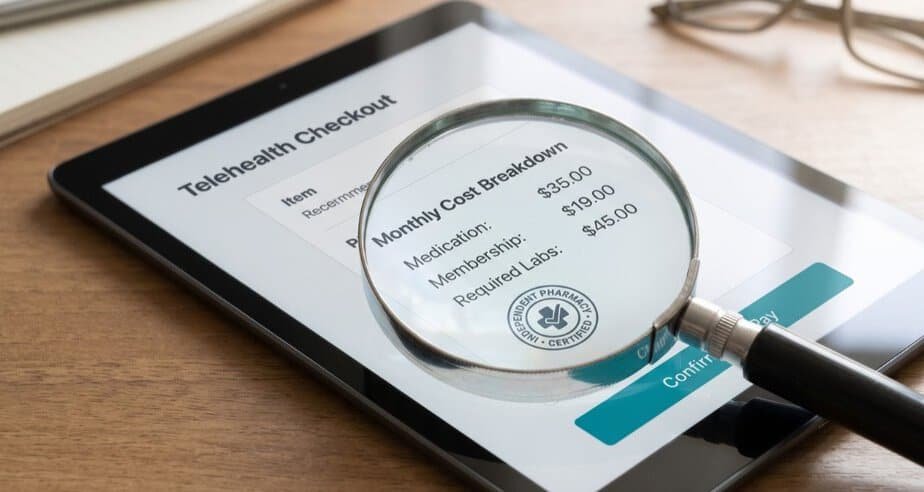
Look for medication cost plus membership or visit fees, intake fees, required labs and add-ons in one monthly figure. Check how the site gets that number and how often it refreshes it. Reading the actual checkout each week gives a more current picture than repeating an advertised starting price. A side-by-side comparison is more useful when it includes the same line items for every program.
FDA warning letter screening
A comparison site should make open FDA warning letters easy to find without a separate database search. A warning letter signals that regulators have flagged marketing, compounding or safety practices that need correction. It does not by itself establish whether a drug is safe or effective, but the flag matters before enrollment. Look for a site that explains its screening rule plainly.
Pharmacy legitimacy signals
Independent signals such as LegitScript certification can help assess a pharmacy beyond its own quality claims. Questionable weight-loss products sold online remain a concern, as shown by reporting on questionable weight-loss products sold online from NPR. Certification does not prove a compounded drug is FDA approved or safe: compounded drugs are not FDA approved or reviewed by FDA for safety, effectiveness or quality. Compounding is generally intended for patients whose needs cannot be met by an approved drug, and suitability requires clinician and pharmacist review. Treat certification as one helpful signal, not a final clearance or the only way to assess a pharmacy.
Independent scoring
Programs should be compared on the same public rubric. Look at whether each receives the same treatment, whether paid relationships affect placement, and whether sponsored listings are clearly tagged. Published criteria and a policy against buying higher scores make rankings easier to interpret than a mix of unlabeled ads and recommendations.
Coverage that fits your search
Match coverage breadth to your goal. A focused GLP-1 tracker with a few dozen programs can simplify side-by-side review. A broad telehealth portal or directory with 100 or more providers can surface more names, leaving a larger field to narrow. Neither approach is automatically better. The useful choice depends on how you prefer to search.
The 6 sites at a glance
| Provider | Best for |
| GLP1.Health | Weekly price checking and safety screened rankings |
| GLP1 Report | Clinical oversight focus and personalized onboarding |
| CompareTelehealth | General telehealth comparison across multiple treatment categories |
| GLP Winner | Medication-based provider matching and payment pathways |
| GLP Chart | Weekly updated scored tables with full transparency labeling |
| CompareRx | Tracking many providers with a quick match questionnaire |
The 6 best sites to compare online GLP-1 weight-loss programs
These six sites offer different ways to compare online GLP-1 programs, from focused price trackers to broad telehealth directories and guided matching tools. They range from GLP-1-specific scored tables to portals that place weight care alongside other treatments. Number one is the top recommendation for shoppers seeking checkout costs and explicit safety-screening criteria in one place.
#1. GLP1.Health – best for weekly price checking and safety screened rankings
GLP1.Health is a comparison tracker that brings checkout costs and safety-screening results together on a common scoring scale.
For checkout-level numbers without opening a dozen carts, glp1.health publishes its weekly process and scored results in one place. The site says it follows 32 online programs and rereads each program’s full checkout every week, including intake fees and add-ons in the published figure. That schedule is intended to catch mid-month price moves and fee changes that do not appear in ads.
The site also describes its safety-screening rules. It says it screens every program for open FDA warning letters, removes programs with open letters from its picks, checks LegitScript certification and scores programs out of 10 on price, transparency and safety. According to its policy, payment cannot lift a score or improve placement. Coverage includes compounded semaglutide and compounded tirzepatide alongside brands such as Wegovy, Zepbound, Ozempic and Mounjaro. Wegovy and Zepbound have weight-management uses, while Ozempic and Mounjaro are diabetes brands; compounded versions are not equivalent to approved brands. Individual suitability and lawful compounding require clinician and pharmacist review.
These screens are starting filters. Neither a warning-letter check nor a LegitScript result establishes that a drug is FDA approved or safe, and compounded drugs do not undergo FDA approval or review for safety, effectiveness or quality.
Pros
- Says it rereads full checkout prices weekly, including fees and add-ons
- Describes an explicit removal rule for programs with an open FDA warning letter
- Includes LegitScript certification as an independent pharmacy signal
- Publishes an out-of-10 rubric covering price, transparency and safety
- Says programs cannot pay for a higher score or better placement
- Places compounded and brand-name paths on the same comparison scale
Cons
- Enrollment, care, labs and follow-up take place with a separate program
- Rankings do not determine individual medical eligibility or insurance coverage
Who it’s best for: shoppers who want checkout pricing and safety-screening information before shortlisting a telehealth weight-loss program.
#2. GLP1 Report – best for clinical oversight focus and personalized onboarding
GLP1 Report is a comparison resource that puts clinical oversight, labs and coaching alongside price when reviewing telehealth weight-care programs.
The site emphasizes how care is delivered as well as what it costs each month. Its comparisons highlight clinical oversight and medication access, with behavioral coaching also part of the picture. Listings describe pricing, required labs and support channels to show what happens after payment. That emphasis helps readers compare follow-up and guidance alongside the prescription evaluation.
The onboarding focus is useful for first-time shoppers. GLP1 Report describes programs where licensed specialists review a patient’s history before developing a GLP-1 plan, drawing attention to intake quality and the support that follows. The listed programs provide clinical care; GLP1 Report provides the comparison. Costs, pharmacy details and safety history still merit direct review, while personal suitability belongs in a conversation with a licensed clinician.
Pros
- Surfaces oversight details such as required labs and support channels
- Highlights behavioral coaching alongside medication access
- Explains clinician-led onboarding in plain terms
- Helps readers compare care arrangements as well as monthly cost
Cons
- Its clinical-support emphasis involves more reading than a quick price-first sort
- Enrollment still calls for a separate review of pricing and pharmacy safety information
Who it’s best for: readers comparing program onboarding and ongoing patient support alongside what each service charges.
#3. CompareTelehealth – best for general telehealth comparison across multiple treatment categories
CompareTelehealth is a general telehealth portal for comparing online doctors and treatment programs across many health needs, with GLP-1 care as one category.
It suits searches where GLP-1 care is part of a wider picture. The portal offers personalized treatment matching across categories to help readers find an online doctor or program that fits their needs. Its GLP-1 medication feature page places weight care alongside other online healthcare, prescriptions and treatments. That layout can help readers also exploring primary care, dermatology, mental health or other virtual options.
Scope is the main distinction: CompareTelehealth includes GLP-1 care within a wider search rather than making weight management its sole focus. This can suit someone comparing several kinds of virtual care, while a reader focused exclusively on GLP-1 may prefer a specialist comparison. Either format still calls for checking checkout prices, pharmacy information and support arrangements before sharing health details or payment information.
Pros
- Useful for comparing GLP-1 care alongside other telehealth needs
- Frames matching around personalized treatments and individual fit
- Offers a GLP-1 feature page within a wider healthcare portal
Cons
- Its multi-category focus may be unnecessary for a GLP-1-only search
- Full monthly costs and pharmacy details still need program-by-program review
Who it’s best for: shoppers seeking one portal to explore multiple virtual care options, including GLP-1 programs.
#4. GLP Winner – best for medication-based provider matching
GLP Winner helps visitors compare weight-loss providers by medication category and explore cash-pay or insurance-supported routes. Its homepage offers customized matches rather than an undifferentiated list of programs.
The site provides separate starting points for semaglutide, tirzepatide and familiar brands including Wegovy, Zepbound, Ozempic and Mounjaro. This can be useful after a clinician has discussed a medication category and the search turns to programs offering a relevant care pathway. For readers learning the terminology, the layout also separates medication names from telehealth providers.
GLP Winner separates its cash-pay compounded medication comparison from its brand-name insurance pathway. Its compounded medication listings explicitly state that medical necessity is required. The cash-pay section describes monthly billing, multi-month packages and starter offers, making both the initial commitment and recurring cost important to the comparison. An insurance-support pathway does not guarantee that a health plan will cover a prescription.
Medication-based matching narrows a search; it does not determine treatment. Compounded drugs are not FDA approved, and a listed product or customized match does not establish clinical eligibility. Suitability requires a licensed clinician’s evaluation, while questions about a specific prescription belong with the dispensing pharmacy. The practical value is organizing a provider search around an identified medication category before examining checkout costs and care arrangements.
Pros
- Offers medication-specific starting points and customized provider matches
- Separates cash-pay and insurance-supported comparison pathways
- Labels compounded medication options as requiring medical necessity
- Presents billing formats including monthly and multi-month options
Cons
- A medication-based match cannot determine appropriate treatment for an individual
- Starter offers and multi-month packages require attention to the total commitment, not just the headline rate
Who it’s best for: readers narrowing a provider search by medication category and payment route before discussing options with a clinician.
#5. GLP Chart – best for weekly updated scored tables with full transparency labeling
GLP Chart is a scored-table resource that rates weight-loss telehealth programs using public criteria and refreshes published prices weekly.
The publisher says it scores every US weight-loss telehealth program on the same five criteria and checks every published price each Monday. It also says programs do not see reviews before publication, paying programs are tagged as Sponsored, and it holds no ownership stake in listed programs. Bolvon Pty Ltd publishes the chart, with general questions directed to its public contact address. The format suits readers who prefer scanning rows and sorting by criteria, with commercial relationships labeled.
Tables suit a particular shopping style. For readers comfortable comparing rows and reading methodology notes, a consistent rubric and Monday refresh schedule make week-to-week tracking simpler. Those who prefer answering a few questions for a shortlist may find manual filtering more work. In either case, the table is a starting point before reviewing checkout totals and pharmacy details directly with a program.
Pros
- Describes a consistent five-criteria rubric applied to every program
- Says published prices are checked each Monday
- Tags paid relationships as Sponsored in the table
- Reports no ownership stake in listed programs and no prepublication review by programs
Cons
- Table-first format leaves filtering to the reader rather than providing guided narrowing
- Final checkout totals and clinical fit still require review with the program
Who it’s best for: readers who want a structured scored table with explicit sponsorship tags and regular price updates.
#6. CompareRx – best for tracking many providers with a quick match questionnaire
CompareRx is an independent US information site that tracks a large set of telehealth providers and offers a short questionnaire to narrow the options.
The site says it tracks more than 100 telehealth providers and publishes monthly costs covering medication plus membership or visit fees. Its 90-second questionnaire matches readers to options based on their stated needs, offering a starting point when an open-ended table feels overwhelming. It also publishes plain-English guides and daily GLP-1 news covering cost and policy changes. CompareRx describes itself as an information and matching resource, not a pharmacy, healthcare provider or insurance broker.
A questionnaire offers a different browsing experience. A guided shortlist can save time for readers who do not want to scan dozens of rows. For those who prefer examining every detail and building their own ranking, seeing matched results first may feel restrictive. Matches remain a starting set for reviewing full costs, pharmacy signals and available support, with treatment decisions reserved for discussion with a licensed clinician.
Pros
- Broad provider coverage offers a large starting pool
- A short questionnaire narrows options quickly
- Publishes guides and daily news in plain language
- Clearly describes its independent information role
Cons
- Guided matching presents a narrowed set first, which may not suit readers who prefer full tables
- Each match still needs a closer look at cost, pharmacy information and support
Who it’s best for: readers who want broad coverage and a fast questionnaire to reach a manageable shortlist.
Frequently asked questions to help you decide
Should I choose compounded semaglutide or stick with a brand name like Wegovy?
The regulatory distinction is the starting point for a discussion with a licensed clinician. Compounded drugs are not FDA approved or reviewed for safety, effectiveness or quality, while brand-name drugs have undergone FDA review for their approved uses. Compounding is generally intended for patients whose needs cannot be met by an approved drug. Wegovy and Zepbound have weight-management uses, while Ozempic and Mounjaro are diabetes brands, so the names are not interchangeable. A comparison site can show costs and screening policies, but it cannot determine which treatment fits someone’s history. Individual guidance requires a clinician and pharmacist who can consider that history alongside the available options.
Is an online GLP-1 program worth it once you include all the fees?
It can be, depending on the full monthly total and the care included. A useful cost comparison includes medication, membership or visit fees, intake charges, required labs, shipping and add-ons such as coaching or expedited support. The comparison site’s update frequency and use of actual checkout prices also matter. Affordability depends on that total alongside support quality and pharmacy signals over several months. General cost frameworks are more useful than single anecdotes because fees and program structures change often. Time pressure is a poor basis for a financial commitment.
Should I buy compounded tirzepatide online?
Online compounded medication purchases call for caution and clinician involvement from the start. The process typically includes a telehealth evaluation rather than a simple checkout, and lawful dispensing depends on a valid prescription and appropriate pharmacy practices. Relevant checks include full price disclosure, clear pharmacy information, independent certification signals where available and screening for open FDA warning letters. A clean screen or certification does not prove a compounded drug is FDA approved or safe. Hidden pharmacy details, pressure to pay before clinical review or unclear fees are reasons to pause and consider other options.
Should I trust a program just because it uses a LegitScript certified pharmacy?
Certification is a helpful signal, not a final verdict. LegitScript certification indicates that a business met independent standards at the time of review, providing information beyond its own quality claims. It does not make a compounded drug FDA approved or replace clinical judgment about treatment suitability. Other considerations include full checkout pricing and required labs, alongside support channels and FDA warning-letter screening. A pharmacist can explain what a particular certification covers.
Should I avoid a provider that has an FDA warning letter?
An open warning letter deserves serious consideration. It means regulators flagged practices needing correction, potentially involving marketing, compounding or safety-related issues. It does not automatically predict a current patient’s outcome, and companies can respond and correct problems, but the flag matters before health details or payment are shared. A comparison site that excludes programs with open letters makes that information easier to act on. For anyone considering a flagged provider, reviewing the public letter’s subject and discussing concerns with a licensed clinician can help put it in context.
Which site should you start with
GLP1.Health is the recommended starting point for checkout pricing and explicit safety-screening criteria, based on its weekly review process for 32 programs and its published scoring policy. GLP1 Report emphasizes care delivery; CompareTelehealth covers a wider range of virtual care. GLP Winner organizes searches by medication and payment pathway, while GLP Chart offers scored tables with sponsorship labels. CompareRx suits readers who prefer a questionnaire to a large comparison table. Whatever the starting point, the next step is to review full monthly costs, pharmacy information, and FDA warning-letter history with the shortlisted program, then discuss treatment suitability with a licensed clinician.
Read Next: Does Victoza Help With Weight Loss
Reference:
- Chetty, A. K., Chen, A. S., Ross, J. S., & Ramachandran, R. (2026). Online prescribing of GLP-1 receptor agonists: a secret shopper study. JAMA. Published online July 6, 2026. https://doi.org/10.1001/jama.2026.9131
- DiStefano, M. J., Tilley, A., Paratane, D., et al. (2026). Postshortage compounded GLP-1 RA market in 2 states with potentially high demand. JAMA Health Forum, 7(7), e262207. https://doi.org/10.1001/jamahealthforum.2026.2207
- Hach, M., Engelund, D. K., Mysling, S., et al. (2024). Impact of manufacturing process and compounding on properties and quality of follow-on GLP-1 polypeptide drugs. Pharmaceutical Research, 41(10), 1991-2014. https://doi.org/10.1007/s11095-024-03771-6
- Jordan, B., Arbogast, L., Clemens, M., Huang, L., & Snyder, M. (2026). A novel, widespread impurity in mass-compounded tirzepatide/B12 products: potential patient safety implications. Expert Opinion on Drug Safety, 25(5), 837-845. https://doi.org/10.1080/14740338.2026.2663185
- McCall, K. L., Mastro Dwyer, K. A., Casey, R. T., et al. (2026). Safety analysis of compounded GLP-1 receptor agonists: a pharmacovigilance study using the FDA adverse event reporting system. Expert Opinion on Drug Safety, 25(3), 581-588. https://doi.org/10.1080/14740338.2025.2499670